Varicose veins are swollen, twisted veins that usually show up on the legs because of poor blood flow. Thanks to modern medical advancements, laser treatment, also called Endovenous Laser Ablation (EVLA), has become a popular and effective option that doesn’t require surgery.
In this blog, we’ll explain in simple terms how laser therapy works, what you can expect during the procedure, and why many people choose it as a safe and reliable solution.
What is Laser Treatment for Varicose Veins?
Laser treatment for varicose veins is a simple, minimally invasive procedure that uses heat from laser energy to close off damaged veins. Instead of removing the vein through surgery, the laser seals it from the inside, allowing blood to flow naturally through healthier veins.
Over time, the treated vein shrinks and is slowly absorbed by your body. This helps reduce symptoms like pain and swelling, while also improving the appearance of your legs.
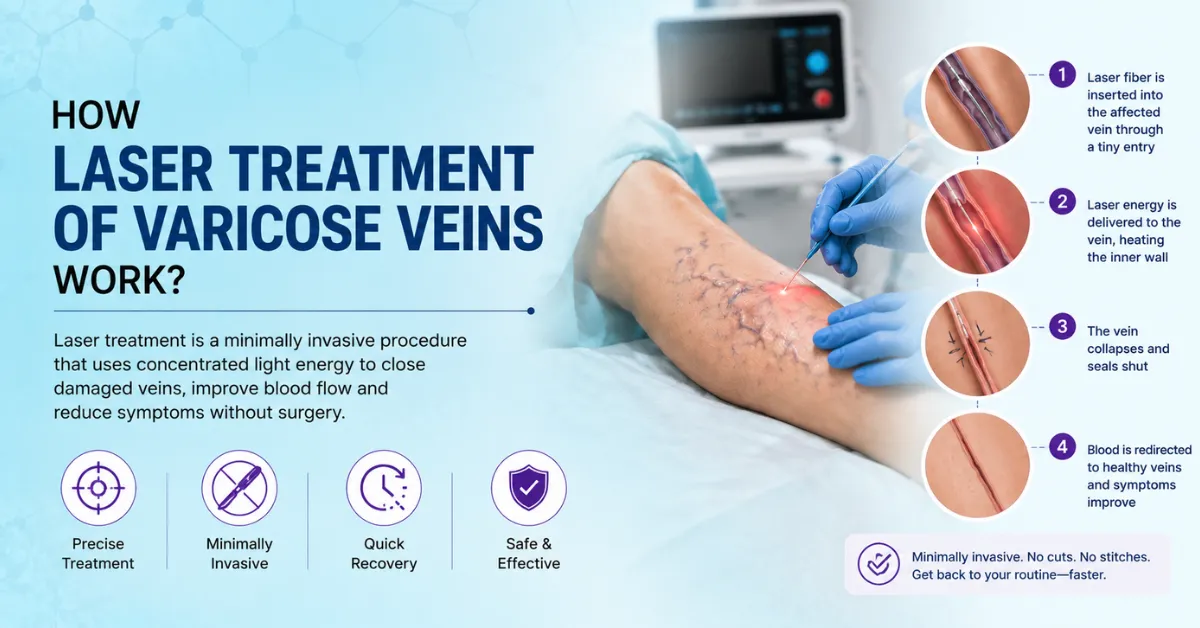
How Laser Therapy Works (Basic Concept)
At its core, laser therapy works on a simple principle:
- A thin laser fiber is inserted into the affected vein
- Laser energy produces controlled heat
- The heat damages the vein walls
- The vein collapses and seals shut
- Blood flow is redirected to healthy veins
This treatment safely closes off the problem vein without the need for major surgery.
Step-by-Step Procedure of Laser Therapy
Laser therapy usually takes about 30–60 minutes and is done under local or general anesthesia. Here’s a simple breakdown of how the procedure works:
1. Vein Mapping and Preparation
Before the procedure begins, the doctor uses ultrasound imaging to locate and map the affected veins. This ensures precise targeting and improves treatment success.
- The path of the vein is marked on the skin
- The treatment area is cleaned and prepared
Ultrasound guidance plays a key role in ensuring safety and accuracy throughout the procedure.
2. Local Anesthesia
A local anesthetic is injected along the length of the vein to:
- Numb the treatment area to minimize discomfort
- To compress veins
- Protect surrounding tissues from heat
This makes the procedure virtually painless for most patients.
2. Insertion of Catheter and Laser Fiber
After local anesthesia a very small incision is made, usually near the knee or ankle. Through this:
- A thin tube (catheter) is inserted into the vein
- A laser fiber is passed through the catheter
The entire process is guided by ultrasound for precise positioning.
3. Tumescent Local Anesthesia
A tumescent local anesthetic is injected along the length of the vein to:
- Numb the treatment area to minimize discomfort
- To compress veins
- Protect surrounding tissues from heat
This makes the procedure virtually painless for most patients.
4. Delivery of Laser Energy
Once the laser fiber is in place:
- The laser is activated
- Controlled heat is delivered to the vein walls
- The doctor slowly withdraws the fiber, gradually treating entire length of vein
The heat causes the vein to collapse and seal shut along its entire length.
5. Completion of Procedure
After treating the vein:
- The catheter and fiber are removed
- A small bandage is applied (no stitches required)
- Compression stockings may be recommended
Patients are usually encouraged to walk immediately after the procedure.
What Happens After the Vein is Sealed?
Once the treated vein is closed:
- Blood is automatically redirected to nearby healthy veins
- The sealed vein gradually shrinks
- The body absorbs the vein over time
This restores normal blood circulation and reduces symptoms like pain, swelling, and heaviness.
Benefits of Laser Treatment
Laser therapy offers several advantages compared to traditional surgery.
Key Benefits at a Glance
|
Benefit |
Description |
|
Minimally invasive |
No major cuts or stitches |
|
Less pain |
Performed under local anesthesia |
|
Quick recovery |
Resume normal activities within 1–2 days |
|
High success rate |
Effective for most patients |
|
Cosmetic improvement |
Visible veins gradually fade |
These benefits are possible because of ongoing improvements in vascular technology. To learn more about how innovations are changing the way treatments are done, check out our guide on Revolutionizing Vascular Care with Expert Technology.
Who is Suitable for Laser Treatment?
Laser treatment is typically recommended for:
- Medium to large varicose veins
- Patients with venous insufficiency
- Individuals experiencing pain, swelling, heaviness or skin changes
- Patients with varicose vein ulcers
- Those looking for a non-surgical solution
However, suitability depends on individual health conditions, and a medical evaluation is necessary before treatment.
Recovery and Aftercare
Recovery after laser therapy is usually quick and straightforward.
What to expect:
- Mild bruising or tightness for a few days
- Walking is encouraged immediately
- Avoid heavy exercise for a short period
- Compression stockings should be worn regularly
Most patients return to normal routines within 24–48 hours.
Are There Any Risks?
Laser therapy is generally safe, but like any medical procedure, it may involve minor risks, such as:
- Bruising or swelling
- Temporary discomfort
- Skin irritation
Serious complications are rare when performed by experienced professionals.
Conclusion
Laser treatment for varicose veins works by using controlled heat energy to seal damaged veins from within, allowing blood to flow through healthier pathways. The procedure is quick, non-surgical, and highly effective, making it a preferred choice for many patients.
With proper diagnosis and timely treatment, laser therapy can significantly improve both comfort and appearance, helping patients regain confidence and quality of life.
At Dev Hospital, patients undergo detailed evaluation to determine the most appropriate treatment approach using advanced vascular care techniques. If you are experiencing symptoms such as leg pain, swelling, or visible veins, it is important not to delay evaluation. Consult an expert to determine whether laser treatment is the right option for you and take a proactive step toward better vascular health.
Frequently Asked Questions (FAQs)
- What is the cost of laser treatment for varicose veins?
The cost varies depending on the severity, location, and clinic, but it generally ranges from moderate to high compared to basic treatments. A consultation is needed for an exact estimate. - How long does laser treatment for varicose veins take?
The procedure usually takes about 45 to 60 minutes for single limb and is done as an outpatient treatment. - How painful is varicose vein laser therapy?
It is usually not painful because it is performed under local anesthesia. Most patients feel only mild discomfort or a slight pulling sensation. - How long does it take to recover after laser treatment?
Recovery is quick, and most people can return to normal activities within 24 to 48 hours, with only mild soreness or bruising. - Is laser therapy for varicose veins safe?
Yes, laser therapy is considered safe and minimally invasive, with a high success rate and low risk of complications when performed by experienced specialists.
